Friday, 17 April 2015

From the archives: A record store is for life, not just for Record Store Day

Originally published on It Is Happening Again on April 23, 2014


It’s 6.25am on Saturday, 19th April, and I’m lying in bed in a London hotel room, trying to decide whether or not to get up, jump on a tube and start queuing outside a record shop in Soho. I’d set my alarm for 6.30am, but I’ve barely slept a wink so I’m already awake – not through excitement, but because of a noisy air conditioning unit that JUST WON’T SHUT UP. The shop in question opens at 8am, but I suspect people will have been queuing since 4am (it later transpires that the first person through the doors had in fact been there since 9.30pm the previous evening).

Why? It’s Record Store Day. In theory, this means that, for one day a year, loyal music fans support their local (or nearest, if you’re away from home, like me) independent record shop by queuing up for hours on end to buy (arguably overpriced) limited edition records produced specifically for this grand occasion – although the alarming speed with which said records find their way on to eBay (usually five minutes after the doors have opened) would suggest that those at the very front of the queue are not always the hardcore fans.

Finally summoning up the strength to get out of bed, I pick up my phone and peruse the list of Record Store Day exclusives that the shop in question has in stock and realise that there are only about three titles I REALLY want – three records that will clearly also be long gone by the time I get anywhere near the counter after two, three, maybe even four hours of queuing. The rest of the list? Well, sure, there are a few bits I wouldn’t mind getting, but can I be bothered to queue for them?

I make an executive decision: I won’t bother. I climb back into bed and finally enjoy the sleep that eluded me for most of the night.


Don’t get me wrong: I fully support the spirit of Record Store Day. Record shops should be celebrated. They may be a rare breed these days, but they still play an important role. For me, record shops helped shape my musical tastes and, in effect, provided my musical education. A knowledgeable person behind the counter is better than any recommendation on Amazon. Independent record shops are run by people who are every bit as passionate about music as you are. Sure, they want to make money (they’ve got to eat, after all) but, for them, running a record shop is about sharing that passion with other people and turning them on to something new. They are also more likely to take a chance on a new, local band, whether this means selling a few copies of your CD, tape or 7” single on the counter, or allowing your band to perform an in-store gig (space permitting, of course). There’s definitely a social aspect to shopping in smaller, independent record stores that you don’t get online or in HMV or your local Tesco.

I’m not going to try to convert diehard downloaders – that’s your decision, of course. However, from a personal point of view, I could spend hours browsing the racks of a well-stocked record shop, but there’s only so long I can stare at a screen while browsing downloads – and besides, when did you last hear anyone say “wow, that’s an impressive MP3 collection you’ve got there”? Sure, they’re convenient but, personally, I would rather spend money on something tangible that I actually OWN.

I support record shops all year round, so I didn’t feel too bad about giving them a miss on Record Store Day this year (although I did pop in on Sunday to browse the leftovers, without the queues). I’m pleased that Record Store Day encourages people to support their local record shop, but it can only work if these people shop there on other days of the year too. That’s what Record Store Day is REALLY about. It is NOT about buying up everything you can just so you can put it on eBay at twice the price – you, sirs, are parasites.

Next year, I may get up early and brave the crowds (last year I queued for more than an hour at a shop in Birmingham with a guy who had not only overstayed his 20-minute parking ticket but got to the front only to decide he didn’t want to buy anything) or I may not.

What I can be sure of, however, is that I’ve learnt a hell of a lot in the 22 years I’ve been visiting independent record shops – and I’m not ready to finish school just yet.

Wednesday, 15 April 2015

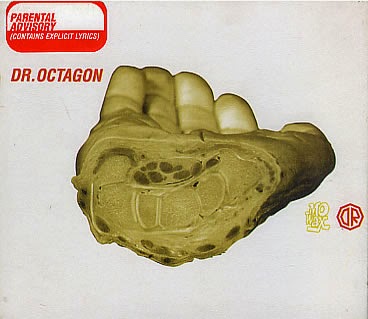
From the archives: Hip Hop Hump Days #4: Dr Octagon – Dr Octagonecologyst (1996)


Originally published on It Is Happening Again on April 16, 2014

“Hello, this is the offices of Dr Octagon. If you have insurance or medical problems, I’m here for you for any type of intestine surgery, rectal rebuilding, relocated saliva glands… and chimpanzee acne. And, of course, moose bumps. You can call 1-800PP51 Doodoo. I’m in your corner.”

And there we have it: the tone is well and truly set for an album which, while not exactly breaking any sales records, is still held up as one of the finest examples of what can be achieved when hip hop is allowed to have a little imagination.

So, who is Dr Octagon? On record, he’s an extra-terrestrial, time-travelling gynaecologist and surgeon who takes something of a sledgehammer approach (literally) to his patients. As a doctor, he is either highly incompetent (“Oh fuck! Patient just died in room 105… nurse/Fuck it, he’s dead/Oh shit, there’s a horse in the hospital”) or downright homicidal (“You need a bad operation… gimme the scissors, hammer, flame/Okay, I’m getting ready to stab… jam it in”).

It’s become a bit of cliché to talk about an album sounding like nothing else released at the time, but in the case of ‘Dr Octagonecologyst’ (see what they did there?) it would be wrong to pretend otherwise. It also pains me to describe it as a concept album, but how else would you describe a record which documents the exploits of a murderous doctor from outer space?


The voice of Dr Octagon is, of course, the reliably eccentric Kool Keith, formerly of Ultramagnetic MCs and the supposed inventor of the ‘horrorcore’ sub-genre of hip hop. The abstract, stream-of-consciousness lyrics, non-sequiturs and vivid horror and sci-fi imagery throughout ensure that Keith truly shines as a rapper who is unafraid to let his imagination run away with him. Sure, the humour can be a little juvenile in places (“What would you do if I hit your face with dog doodoo?”) but it all adds to the surreal, dream/nightmare-like charm of the record.

Although technically Kool Keith’s first solo album, it would be unfair to overlook the contribution made by Dan The Automator, who provides the cinematic, psychedelic and often unsettling soundtrack, and Q-Bert, whose scratching demonstrates why he won so many successive world titles for his turntable skills. It’s to their credit that an instrumental version of the album was released later that same year and still managed to sound like a complete record, even without Kool Keith’s vocals.

‘Dr Octagonecologyst’ didn’t reach anywhere near the sales of, say, 'The Chronic', but then who says Dr Octagon set out to make friends in the first place? This isn’t about following the rules. This is about doing something completely different JUST BECAUSE YOU CAN. Hip hop is all about expression and if you can’t express yourself then you may as well just give up.

The doctor will see you now.

Wednesday, 8 April 2015

From the archives: Hip Hop Hump Days #3: EPMD – Strictly Business (1988)


Originally published on It Is Happening Again on April 2, 2014

“Who the hell are EPMD?” some of you may be asking. That’s understandable. Their videos aren’t plastered all over the TV music channels (well, those that still play music these days), they aren’t selling out stadium concerts or headlining festivals around the world and you don’t hear their music blasting out from people’s phones at the back of the bus.

The most influential musicians are not necessarily those who top the charts or play sell-out tours. Even if you haven’t heard of EPMD, you’ve undoubtedly heard and hopefully enjoyed music that probably wouldn’t have existed without their influence.

Part of hip hop’s golden age, Erick Sermon and Parrish Smith pioneered a sample-heavy funk-based sound which would serve as a blueprint for countless – and considerably more successful – other artists after them. Dr Dre’s ‘The Chronic’? Yep.  Snoop’s ‘Doggy Style’? Uh huh. The whole G-Funk era? Of course. Interestingly, later editions of ‘Strictly Business’ would include ‘Snoop Dogg approved’ on the cover – the student endorses his teachers.


As an album, ‘Strictly Business’ doesn’t really have a specific message, as such. Public Enemy were fighting the power. NWA weren’t overly keen on the law enforcement officials in their neighbourhood. EPMD, on the other hand, just wanted to party. For all the authoritative overtones of its title, ‘Strictly Business’ was a warm, light-hearted affair. Whatever ‘business’ EPMD had in mind, it sounded like something you wanted to be part of.

The opening title track sets the tone. The funk-fuelled backing track and the snatches of Eric Clapton’s cover of Bob Marley’s ‘I Shot The Sheriff’ (almost a decade before Warren G would have global success with his own version – there’s that influence again) provide the soundtrack for EPMD’s trademark deadpan delivery. Elsewhere, we find samples from Steve Miller, Kool and the Gang, Aretha Franklin, Pink Floyd, Michael Jackson and even ZZ Top – all thrown into a rich musical melting pot with astounding results.

Vocally, the delivery is smooth, confident and in many ways a lot more accomplished than the ‘child reading a prayer in school assembly’ style of some MCs of the time (yeah, I’m looking at you, LL Cool J). It’s a style that’s easy to listen to – remember, you’re allowed to like music simply because it sounds good, rather than because there is a message or an agenda.

EPMD have released seven albums in total, all with the word ‘business’ in the title and all containing a track called ‘Jane’ (give it up, guys – she clearly ain’t interested). However, nothing has come close to ‘Strictly Business’ and, more importantly, the foundations it would lay for those who came later.

If you don’t know, get to know. If you’ve forgotten, then it’s time to refresh your memory. Alternatively, you could just carry on listening to your Pitbull or Professor Green albums and pretend none of this ever happened.

Your move.

Wednesday, 1 April 2015

From the archives: Hip Hop Hump Days #2: Wu-Tang Clan – Enter the Wu-Tang (36 Chambers) (1993)


Originally published on It Is Happening Again on March 26, 2014

There wasn’t much excitement in the former mining town where I grew up. We always joked that when the ‘90s came around, its residents would be right on the ball. We made this joke in 1995.

So, it caused something of a stir when the townsfolk awoke one morning to find strange, ‘foreign-sounding’ names sprayed in large black letters across shop fronts, shutters, brick walls and, well, anywhere with a surface really.

‘Wu-Tang Clan.’

Who were they? What did they want? One person I spoke to suggested that a Triad-style Chinese gang had moved into town and its members had set about marking their territory across the frontages of Woolworths and Clinton Cards to show everyone that they meant business.

The names of their leaders were also there for all to see: Method Man. Chef Raekwon. Ghostface Killah. Ol’ Dirty Bastard?!

The graffiti has long since gone, of course, but looking back, it’s difficult to tell what the good townspeople would have found more frightening: a Triad takeover or what those spray-painted words REALLY signified.

Enter the Wu-Tang.

When the Staten Island collective first burst on to the scene more than two decades ago, it was clear that they were not like other rappers. Their music was too brutal to be lumped in with the warmer G-Funk sound emanating from the opposite West Coast. Equally, it didn’t take itself too seriously, unlike a lot of the hardcore gangsta rap at the time.

It’s no understatement to say that ‘Enter the Wu-Tang (36 Chambers)’ was a total game-changer. They were less a gang and more a movement, masterminded by de facto leader and producer RZA. They established an identity which went way beyond their music: it’s a safe bet that more people have heard the name Wu-Tang Clan than have actually heard their music – not to mention those unaware that Wu-Tang is anything more than a clothing label (yep, the Wu empire conquered that market too). But I digress…


"Shaolin shadowboxing, and the Wu-Tang sword style. If what you say is true, the Shaolin and the Wu-Tang could be dangerous. Do you think your Wu-Tang sword can defeat me?"

"En garde. I'll let you try my Wu-Tang style."

This opening dialogue, lifted from obscure late 70s/early 80s Hong Kong films, sets the tone for the album. The kung fu mythology theme is one which runs throughout the record – indeed, ‘Enter the Wu-Tang (36 Chambers)’ is divided into two sections: Shaolin Sword and Wu-Tang Sword. The battle theme is also evident in the Clan members’ lyrical style – each track sees selected members (rarely do they all appear together) square up to each other on the mic, flexing their lyrical muscles to see who can outdo the other with the most out-there free-association lyrics which veer between downright brutal and frankly hilarious, often blurring the two (the torture scene skit at the start of ‘M.E.T.H.O.D. Man’ is a case in point). Who wins these battles? Who cares? The results are never anything less than dazzling, regardless.

Musically, it’s difficult to find comparisons – even Wu-Tang Clan themselves failed to match their own stunning debut (although solo efforts from GZA and Raekwon came pretty damn close). In other words, this record is like nothing else that came before it. There is very little in the way of hooks or choruses and where other hip hop acts of the day would simply lift old songs wholesale and use them as the basis for their new tracks, RZA would instead take snippets of forgotten soul and funk and turn those brief snatches of music into instruments in their own right. The cheap equipment used during the recording process lends the album a raw, dusty sound, while the samples themselves (the sparse Chinese yangqin on ‘Da Mystery of Chessboxin’’ or the ghostly piano on ‘C.R.E.A.M.’, for example) give the whole record an eerie, unsettling tone, as if you’re eavesdropping into the Clan’s conversation and any minute now you’re going to sneeze or nudge whatever you’re hiding behind and give the game away. Wu-Tang Clan Ain't Nuthing Ta F' Wit. 

If your opinion of Wu-Tang Clan is based solely on ‘Gravel Pit’ (an uncharacteristically radio-friendly offering by their standards), then you’ve got some serious catching up to do, my friend. ‘Enter the Wu-Tang (36 Chambers)’ is your starting point.

Listen and learn.

Wednesday, 25 March 2015

From the archives: Hip Hop Hump Days #1: Jurassic 5 – Jurassic 5 (1998)


Originally published on It Is Happening Again on March 18, 2014

Glastonbury, 25 June 2010. It’s hot. Too hot. We’re queuing up to meet Chali 2na. He’s just come off stage, having performed with Breakestra, and is chatting to fans, signing autographs and posing for photos.

Jurassic 5, the hip hop collective which made him famous, split up three years earlier, citing the classic “musical differences” and, since then, Chali has busied himself with a plethora of collaborations, including with the aforementioned Breakestra.

It’s our turn. We were at the back of the queue, but he treats us like we’re the first people he’s seen all day. Handshake. Autograph. Photograph. Then the journalist in me kicks in and I start asking him questions.

Has he performed at Glastonbury before? He has.

Was that with Jurassic 5? Affirmative.

Will Jurassic 5 perform together again? Uh…

He looks awkward. This cannot possibly be the first time he has been asked that question today. WE WERE AT THE BACK OF THE QUEUE.

“You’re all working on your own projects at the moment, right?” I chip in.

He looks relieved.

“Uh… yeah, yeah.”

“Well, hopefully we’ll see you guys back together again soon,” I quip, optimistically.

He gives me a smile which betrays a hint of pity and puts his hand up for one of those handshake/high-five hybrid things, saying: “Aw, respect man.”

---


I first encountered Jurassic 5 while at university in 1998. One of my housemates had their self-titled debut and I was immediately struck by the way it managed to sound so old skool and yet… so new, so fresh.

From the off, it was clear that this was the real deal. J5 weren’t concerned with guns, bitches and bling (which, as the great philosopher Scroobius Pip once reminded us, were NEVER part of the four elements and NEVER WILL BE). Theirs was not a world of macho posturing or pointless playground beefs based on territorial disputes and perceived disrespect. They had no need to pretend: every claim of lyrical prowess was instantly backed up. The evidence was right there in your hands, on your turntable, embedded in your consciousness.

So what about the album itself? Firstly, ‘Jurassic 5’ isn’t technically an album, per se, but more of an extended version of their earlier self-titled EP. Of the 13 tracks, just six are what you might call ‘songs’ (I hate to use that term in relation to hip hop but you know what I mean, right?) while the rest are either brief skits (‘Sausage Gut’, ‘Set Up’) sample-heavy instrumentals (‘Lesson 6: The Lecture’) and ‘reprises’ (in other words, shortened instrumentals) of earlier tracks. However, far from sounding fragmented or disjointed, everything comes together to create a mini-masterpiece which has stood the test of time.

Musically, this is hip hop stripped back to basics. Four MCs, two DJs. That’s it. What more do you want? Jarring kids’ TV samples shoe-horned into your track to get commercial radio play? Nah. P Diddy producing your record on the condition that he’s allowed to dance like a twat in your video? Not on their watch. Your own line of over-priced, garishly coloured headphones which look like something you would buy from the Early Learning Centre? GET OUT AND DON’T COME BACK.

Taking its cue from the conscious hip hop of De La Soul and A Tribe Called Quest, this is an album where substance takes precedence over style. What sets J5 apart from their peers is their smooth lyrical flow and four MCs rapping together as one, almost harmonising in places. These aren’t people who ‘think’ they can have a go at rapping – these are people with a talent that others should aspire to. The standard has been set.

It’s coming up to 16 years since ‘Jurassic 5’ was released. To this day, it remains one of the albums I play the most. The day I get bored of it is the day I stop breathing.

---

O2 Academy, Birmingham, 11 June 2013. It’s hot. Too hot. We’re queuing up to meet Chali 2na. He’s just come off stage, having performed with a reformed Jurassic 5, and is chatting to fans, signing autographs and posing for photos.

It’s our turn. We were at the back of the queue, but he treats us like we’re the first people he’s seen all day. Handshake. Autograph. Photograph.

I resist the urge to say “I told you so”.

Wednesday, 25 February 2015

The crud, the bland and the fallen Madonna


As weird as it sounds, there’s something ever so slightly reassuring about the Brit Awards being shit.

They’re consistent – you know where you stand with the Brits. You go in expecting to be disappointed by the overwhelming blandness of such a relentlessly corporate affair and those expectations are always met. And anyway, we’d only have to find something else to complain about if this changed.

Last year, I made a point of not watching the Brits (explaining why here), but for 2015’s awards I decided to bite the bullet and subject myself to just over two hours of musical diarrhoea, vomit-inducing sycophancy and veteran pop singers hitting the floor at considerable speed, recording my thoughts in the process.

Don’t say you weren’t warned…

8pm – proceedings kick off with a frankly bizarre but mercifully brief ‘dance’ routine involving a banquet which feels like it’s on the verge of erupting into the kind of party where car keys are pulled from bowls. Nothing quite says ‘the best of British music’ like dour-faced celebrity chef Marco Pierre White, does it? And that’s probably why he was chosen to put an end to this utterly pointless routine by lifting the lid on a giant silver serving plate to reveal our cheeky, chirpy hosts for this evening’s ‘merriment’… yup, Ant and Dec. Hey, at least it’s not James Corden again.

8.05pm – if Taylor Swift’s opening performance excels at anything, it’s being lacklustre. She looks and sounds like she’s there because she has to be. ‘Blank Space’? I’ll say.

8.09pm – Dec warns us that Kanye West is in the building. I think it’s going to be one of those nights where I’d happily see him ruin anyone’s acceptance speech. Fingers crossed for Sheeran or Smith, eh?

8.11pm – first painfully predictable award of the night goes to Ed Sheeran for Best British Male Solo Artist. Presented by Orlando Bloom and Rita Ora (looking like a deflated Brigitte Nielsen), Sheeran steps up to receive something resembling an ornament from your grandma’s downstairs toilet. Kanye nowhere to be seen, but the night is young.


8.20pm - “Are you having a great time? I know I am," says Jimmy Page without so much as a hint of enthusiasm in his voice as he prepares to present the award for Best British Group to Royal Blood. The Twittersphere is awash with furious One Direction fans who, like, totally, literally, cannot BELIEVE an award has gone to someone they’ve never heard of.

8.23pm – we’re ‘treated’ to a live performance by whimpering robot Sam Smith. Maybe I’m missing something here, but how can someone marketed as a supposed soul singer make music that is so devoid of any actual soul? Mute button.

8.36pm – Excruciating effort at ‘humour’ between Lewis Hamilton and Ellie Goulding (admittedly neither are renowned for their razor-sharp wit and comic timing, but still…) as they shuffle on stage looking like the happy couple at a second-rate footballer’s wedding to present the Best International Female toilet decoration to Taylor Swift, who promptly dedicates it to tea and all things British.

8.40pm – Royal Blood perform live, presumably fuelled by the bitter, stinging tears of livid One Directioners. I like to think that future Royal Blood riders will include, nay, DEMAND barrels of the stuff.

8.51pm – Simon Cowell’s mouth botox doesn’t appear to have worn off yet. Either that or he’s just pissed. Either way, tonight he looks less like a music impresario and more like an inebriated English teacher sitting out a dance at the school prom.

8.56pm – a busker seems to have wandered on stage while no one’s looking. Oh, wait – it’s Ed Sheeran, comin’ on like a Games Workshop Justin Timberlake. At one point, he looks like he’s actually trying to put his guitar out of its misery. I wish I was that guitar.

9.11pm – “Everyone has to get up on their feet and welcome my husband, Kanye West!” shouts professional oxygen thief Kim Kardashian before His Lordship takes to the stage with what appears to be the entire population of a small town (I assume for protection in case Beck decides to crash the party) for a performance which TV bosses keep muting, despite it being shown after the watershed. Is this the most pointless television performance ever? To be fair, I’d probably still be asking that question even if it wasn’t being muted.

9.16pm – for some inexplicable reason, Zac Efron in drag comes on to present the award for Best International Male Solo Artist. Oh no, wait, it’s Cara Delevingne. Winner Pharrell Williams can’t be arsed to turn up so he sends a video in which he says “Best International Solo Artist? I don’t know…” – which, funnily enough, is exactly what I was thinking.

9.26pm – Ant and Dec do the sort of ‘comedy’ routine they’d have done when they still did kids’ TV and which even the Chuckle Brothers would now dismiss as ‘dated’. I’m rapidly starting to lose interest and a live performance by Take That (now just a three-piece following Jason Orange’s departure to focus on… oh, fuck knows) fails to reverse the situation. I’ve forgotten the song already and they haven’t finished performing it yet.

9.40pm – identikit busker-done-good George Ezra tries to liven up a predictably dull performance by giving full-blown hipsters jobs in his backing band. As charitable as that may be, the whole thing just feels flat and lifeless. He’s performed ‘Budapest’ so many times that even he sounds bored of it now.

9.50pm – award number two (in every sense) for Sam Smith as he wins British Breakthrough Act. Just to rub salt into the wound, someone’s seen fit to ask Fearne Cotton to present the award. Kanye, where are you? Bring the flamethrower.

9.56pm – “British music is the best, isn’t it?” yelps an over-excited Ant. Indeed. Maybe we should have an awards ceremony recognising the best of British music. I can’t think of anything more exciting.

9.58pm – Wand Erection finally win an award for Best British Video and they haven’t even turned up to collect it. An increasingly dishevelled looking Cowell accepts it in their place. To be fair, he’s the only one who’s actually had any input into their career to date so he may as well have their award too. I still want to smash my face into the nearest wall, however.

10.06pm – Russell Crowe presents what we are promised is the final award of the night, for Best British Album. It’s fucking Ed Sheeran again. Crowe shakes his hand like a headteacher congratulating his star pupil on winning the school science prize. Sheeran ponders flogging his award because “it’s a Tracey Emin, innit?” You might get some money for that guitar too. Just a thought.

10.11pm – it’s a sad indictment on the Brits that the most interesting thing about the whole sorry affair is Madonna falling off the stage with a not inconsiderable thump, inadvertently creating what will no doubt be the defining moment of this year’s awards. To be fair, she dusts herself off and carries on but as comebacks go… ouch.

Saturday, 14 February 2015

Cooking with Gaz


Gaz Coombes – live @ The Glee Club, Birmingham, 09/02/15


Applause, then darkness.

“Hello Birmingham… I can’t see shit!”

As opening lines go, it’s certainly unusual, but occasional technical gremlins aside (the stage is accidentally plunged into darkness as the band comes on stage), Coombes seems perfectly at home in such an intimate venue, particularly when you consider that, in a previous life, he regularly played to tens of thousands of people at festivals around the world.

Touring in support of second solo album Matador, Coombes is quoted as saying that he just wanted to make a record he was into – and tonight it shows. Whereas Supergrass were seen as an integral part of the mid-90s Britpop explosion, Coombes is now at that enviable point in his career where he doesn’t have to be part of any ‘scene’. It’s an old cliché, but he really is making music for himself and if the rest of us like it then it’s a bonus – and, as it turns out, a lot of us DO like it. A LOT.

He still knows his way around a tune, of course. Matador’s strength lies in the way its songs manage to permeate your consciousness. When he plays album highlight 20/20 tonight, it feels like a song we’ve known all our lives, even though many of us (myself included) only heard it for the first time little more than a month ago.

“You’re one of the politest crowds I’ve ever played to,” he observes. And he’s right.  Tonight’s crowd may be somewhat reserved but it’s more through quiet reverence than lack of enthusiasm. It’s THAT kind of gig – the one which those who were there will still talk about in hushed tones in years to come.

Songs from Matador, such as The English Ruse, Detroit, Needle’s Eye and Seven Walls, sit comfortably among material from 2012 debut Here Come The Bombs, showcasing Coombes’ knack for writing epic, widescreen tunes incorporating stark electronica and even elements of Krautrock (the motorik beat and one-note repetition are evident here a few times) with compelling results.

Set closer Break The Silence (from the first album) becomes an extended glam rock disco stomper which gives Coombes an opportunity to introduce us to a backing band who have clearly enjoyed every second of tonight’s performance as much as their frontman. It’s only at this point that I realise Loz Colbert from Ride is the drummer.

He doesn’t play any Supergrass songs, of course – and he doesn’t need to. His solo material more than speaks for itself.